Electrostatic actuation breaks the tradeoff between phased arrays and deployable reflectors for one aperture that reconfigures on command, built for a fraction of the cost of either.
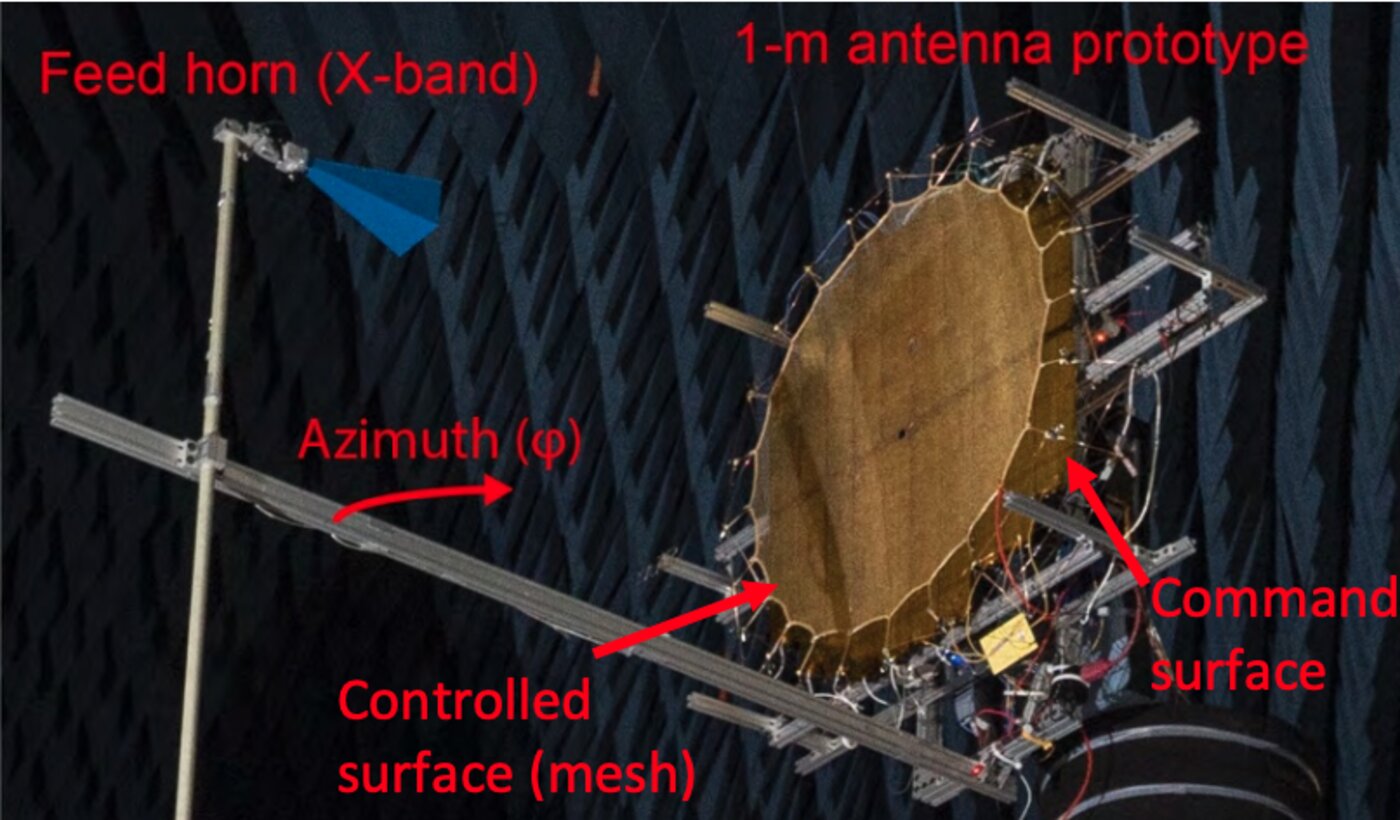
An electrode array sits behind a large, lightweight conductive membrane. Applying bias voltage across the gap reshapes the membrane's surface dynamically. No motors, no gimbals, no moving parts to fail.
That electrostatic control gives a single reflector real-time beam steering, aperture reconfiguration, and thermal-distortion correction, all from software. Because it replaces motors, gimbals, and precision deployment mechanisms with nothing but electrostatic force, the result is a hardware platform with the adaptability of a phased array — built and produced for less than a traditional deployable reflector, at a tenth the power of a phased array.
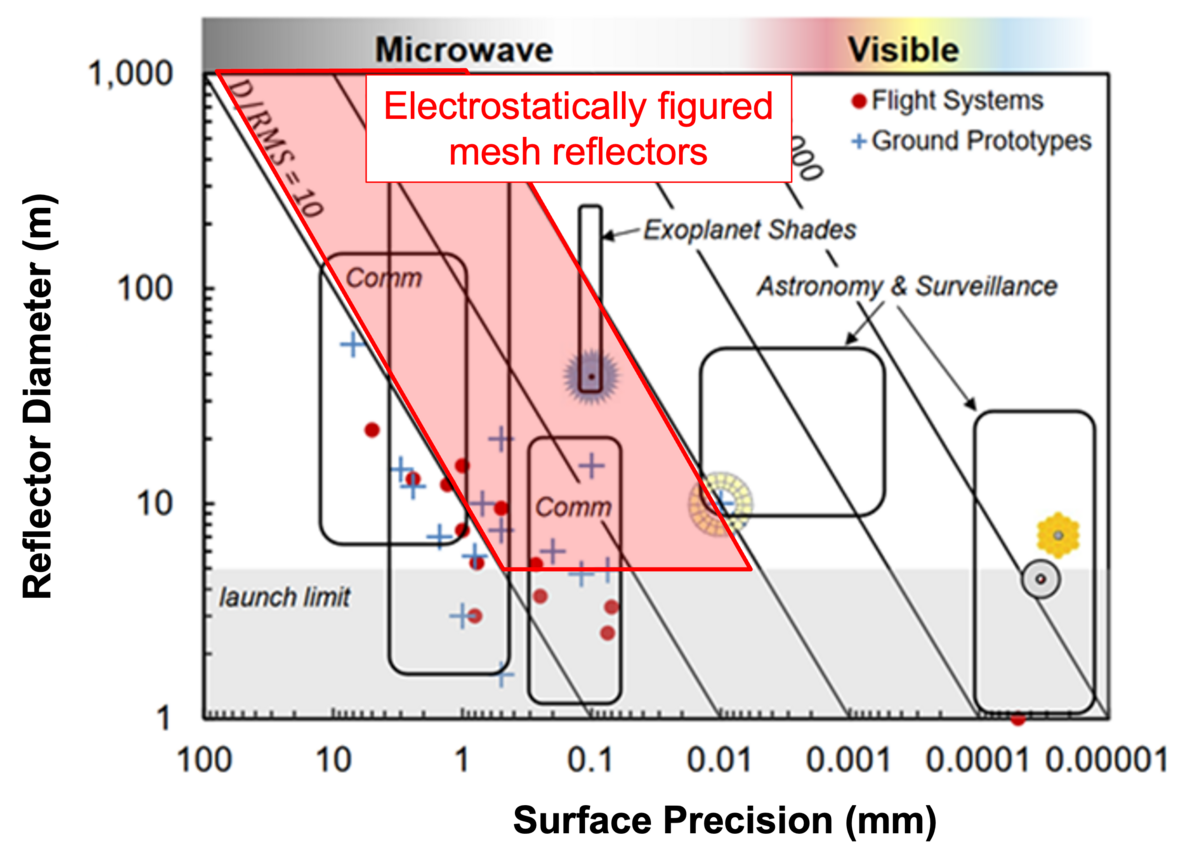
Every RF engineer working on space systems knows the wall: long-range radar and high-throughput satcom both need large, adaptive apertures, and the physics has been clear for decades. What hasn't existed is hardware that can deliver that adaptability affordably.
By figuring a mesh reflector's surface electrostatically instead of mechanically, Mithril extends precision control to apertures and mass budgets that were previously out of reach — without the launch-mass penalty of a rigid, motor-actuated structure.
Reconfiguring on orbit is a software change, not a hardware redesign.
A large reconfigurable aperture tracks resident space objects and monitors activity across MEO, GEO & cislunar - orbits that are largely unwatched by any commercial sensor today.
The same steerable, reconfigurable reflector eliminates the bottleneck of large-aperture lead times & high costs, opening upper orbits to more users.
One platform, two markets, switched in software. Defense and commercial missions share a single hardware line and cost structure.
Ground testing can validate actuation in a lab vacuum chamber, but it can't replicate the ambient plasma environment of low Earth orbit. VERA is a flight experiment designed to close that one remaining gap between lab-proven physics and an operational design — advancing the technology from TRL 4 to TRL 6.
A ~15 kg external payload (electrode array, conductive mesh membrane, onboard metrology, and controller) installed during standard ISS crew operations.
Fully autonomous voltage-sweep scripts run over a 90-day baseline mission with no further crew interaction, consumables, or deployment mechanisms.
Controlled membrane deflection, characterized plasma effects, long-duration stability, and flight-calibrated force models all form the data set that de-risks a space-based radar network.
We're always glad to talk with partners, researchers, and future teammates.